


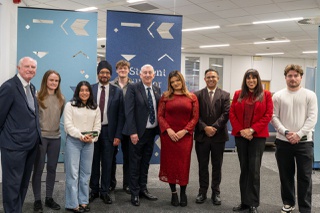



Dr Komali Yenneti
Reader in 'Urban Sustainability' and Head of Partnerships (Academic Quality)
- Email komaliy@wlv.ac.uk
- Faculty FSE
- Campus Springfield Campus
- School School of Architecture and Built Environment
Dr. Komali Yenneti is an interdisciplinary researcher and educator with expertise in human geography, urban studies, and environmental planning. She brings over a decade of international academic, research, and policy experience, having worked across the UK, India, Australia, and China. She currently serves as the Chair of Quantity Surveyors International (QSi) – UK & Ireland Board and was the founding Chair of the International Geographical Union Young and Early Career Geographers Commission. She is a Fellow of the Royal Geographical Society (FRGS) and a Fellow of the Higher Education Academy (FHEA).
Over the course of her career, Dr Yenneti has held a range of academic roles, including postdoctoral researcher, research fellow, lecturer, senior lecturer, and principal lecturer. She is currently seconded as a Building Science & Climate Change Specialist at the Department for Energy Security and Net Zero. She also serves as Joint Coordinator for REF 2029 (People, Culture and Environment) for Unit of Assessment C13 (Architecture, Built Environment and Planning). She is the Joint Chair of the University of Wolverhampton's Women’s Staff Network (WSN) and has previously contributed to academic governance as a member of the Faculty of Science and Engineering Learning, Teaching and Assessment Sub-Committee.
Dr Yenneti's research focuses on the UN-Sustainable Development Goals, particularly Affordable and Clean Energy (SDG 7), Sustainable Cities and Communities (SDG 11), and Reduced Inequalities (SDG 10). Her work has generated impact across areas such as smart cities, urban climate change, energy efficiency and renewable energy, urban inequalities, and gender. She is deeply committed to developing policy-relevant research and strategic partnerships that enhance knowledge exchange and maximise societal impact.
A strong advocate for inclusive and transformative futures, Dr Yenneti places community participation, interdisciplinary collaboration, and policy engagement at the heart of her work. She has made significant contributions to curriculum design, internationalisation of education, student support, and mentoring of early career academics, alongside advancing equality, diversity, and inclusion initiatives within higher education.
Urban Inequalities, Urbanisation in Global South, Sustainable Cities, Socio-Spatial Vulnerabilities
Urban Overheating, Heat Vulnerability, Urban Climate Adaptation & Resilience, Green Infrastructure
Low-carbon Transitions, Net-Zero, Energy Efficiency, Renwable Energy, Low-carbon Buildings
GIS, Data-Augmented Design, Digital Analytics, and Spatial Decision-Making
2024-present:Association for Learning Technology (Associate Member) (MALT)
2023-present National Association of Women in Construction (UK & Ireland) (Member) (MNAWIC)
2023-present Quantity Surveyors International (Member and Board Member) (MQSi)
2023-present The Retrofit Academy (Member)
2021-present Royal Geographical Society (Fellow) (FRGS)
2022-present British Higher Education Academy (Fellow) (FHEA)
2019-present Indian Town Planning Institute (Associate Member) (AITPI)
2010-present Indian Council of Architecture (Registered Architect and Life Member) (RACA)
PG Diploma in ‘Retrofit Coordination and Risk Management’, The Retrofit Academy’s Level 5 course (13 credits)
PG Cert in Higher Education & Professional Practice (accredited by HEA), University of Wolverhampton (Distinction)
PhD (Geography + Environmental Sciences) in School of Geography, Earth and Environmental Sciences, University of Birmingham, UK (Passed with No Corrections)
PG Diploma in Urban Management Tools in Climate Change, Institute of Housing and Urban Development Studies, Erasmus University, Rotterdam, The Netherlands
Master of Planning (Environmental Planning), Faculty of Planning & Public Policy, CEPT University, Ahmedabad, India (Distinction with Gold Medal)
Bachelor in Architecture, School of Planning and Architecture (SPA), Jawaharlal Nehru Technological University (JNTU), Hyderabad, India (First Class with Gold Medal)
Edited Books
2024. Wood, G., Onyango, V., Yenneti, K., and Liaopolou, M., (ed.). The Palgrave Handbook of Zero Carbon Energy Systems and Energy Transitions, Palgrave MacMillan, pp.990, ISBN: 978-3-030-74380-2
2024. Golubchikov, O. and Yenneti, K. (ed.) Smart Cities, Energy and Sustainability: Governing Cities to a Low Carbon Future, Wiley-Blackwell, pp.416, ISBN: 978-1-118-64066-1
Special Issues
2024: Yenneti, K., Palme, M., Pignatta, G. The Policy, Politics, and Governance of Sustainable Energy Transitions. Sustainability
2023: Ren, F., Li, B., Huang, J., Liu, D., Liu, X., Yenneti, K. Meteorological Disasters and Meteorological Disaster Chains , Frontiers in Earth Science
2021: Sikka, G., Yenneti, K., Singh, R.B., Tikunov, V. Special Issue – Geospatiality and Sustainable Development Goals (SDGs). Geography, Environment and Sustainability (Official Journal of Russian Geographical Society)
2021: Yenneti, K., Golubchikov, O., and Lamberts, R. Special Issue - The Varieties of Energy Poverty: A Global Perspective, Energy and Buildings
Peer-reviewed Journal Articles
2025 Mudofir, M., Astuti, S.P., Purnasari, N., Sabariyanto, S., Yenneti, K. and Ogan, D.D.D., Waste harvesting: lessons learned from the development of waste-to-energy power plants in Indonesia. International Journal of Energy Sector Management. 1750-6220.
2024 Vanderhorst, H., Heesom, D. and Yenneti, K. Technological advancements and the vision of a meta smart twin city. Technology in Society, p.102731.
2024 Tripathi, S., Yenneti, K*. Does inequality in urban population distribution lead to income inequality? Evidence from India., Asia-Pacific Journal of Regional Science, pp.1-32.
2023 Teimouri, R., Karuppannan, S., Sivam, A., Gu, N., and Yenneti, K. Exploring International Perspectives on Factors Affecting Urban Socio-Ecological Sustainability by Green Space Planning. Sustainability, 15(19). 14169
2023 Zanganeh, A., Khademi, N., Farahmandmoghadam, N., Ziapour, A., Naderlou, R., Oghli, S.S., Teimouri, R., Yenneti, K. and Moghadam, S. Spatiotemporal clustering of suicide attempt in Kermanshah, West Iran. Frontiers in Psychiatry (Sec.Public Mental Health). 14
2022 Zanganeh, A., Ziapour, A., Naderlour, R., Teimouri, R., Janjani, P., and Yenneti, K. Evaluating the access of slum residents to healthcare centers in Kermanshah Metropolis, Iran (1996–2016): A spatial justice analysis.
2022 Alizadeh Zenouzi, S., Yenneti, K*., Teimouri, R., Abbasiyan, F., and Palme, M.. Analysis of changes in vegetation index during the rapid urban spatial development period (1990-2020) in Tehran Metropolis, Iran. Atmosphere. 13(12): 2010
2022 Manapragada, N.V.S.K., Shukla, A.K., Pignatta, G., Yenneti, K., Boorla, V., and Nayak, B.K. Development of the Indian Future Weather File Generator based on Representative Concentration Pathways. Sustainability, 14 (22):15191.
2022 Khademi, N., Zanganeh, A., Ziapour, A., Saeidi, S., Teimouri, R., Yenneti, K., Moghadam, S., Almasi, A., and Golanbari, S.Z. Exploring the epidemiology of suicide attempts: Risk Modelling in Kermanshah, Iran. Health and Justice, Frontiers in Public Health, 10: 924907
2022 Zanganeh, A., Yenneti, K*., Teimouri, R., Saeidi, S., Najafi, F., Shakiba, E., Moghadam, S., and Shadmani, F.K. The Spatiality of COVID-19 in Kermanshah Metropolis, Iran, Urban Science, 6, 30 (Q1) (50%) 2021 Kantamaneni, K., Rice, L., Xiaoping, Du., Belqais Allali, Yenneti, K. Are current UK coastal defences good enough for tomorrow? An assessment of vulnerability to coastal erosion. Journal of Coastal Management, 142-159
2021 Sikka, G., Yenneti, K., Singh, R.B. IGU-YECG Special Issue: Geospatiality and Sustainable Development Goals. Geography, Environment, Sustainability. 2021;14(1):6-8
2020 Yenneti, K., Ulpiani, G., Santamouris, M., Ding, L., Paolini, R., Haddad, S. and Prasad, D. Urban overheating and cooling potential in Australia: An-evidence based review. Climate, 8(11),126
2020 Tripathi, S., and Yenneti, K. Measurement of Multidimensional Poverty in India: A State-level Analysis. Indian Journal of Human Development, 14 (2), 257-274
2020 Kantamaneni, K., Rice, L., Yenneti, K., Campos, L. Assessing the Vulnerability of Agriculture Systems to Climate Change in Coastal Areas: A Novel Index. Sustainability, 12(11), 4771
2020 Santamouris, M., Paolini, R., Haddad, S., Synnefa, A., Garshasbi, S., Hatvani-Kovacs, G., Gobakis,K., Yenneti, K., Vasilakopoulou, K., Feng, J., Gao, K., Papangelis, G., Dandou, A., Methymaki, G., Portalakis, P., and Tombrou, M. Heat Mitigation Technologies can Improve Sustainability in Cities An Holistic Experimental and Numerical Impact Assessment of Urban Overheating and Related Heat Mitigation Strategies on Energy Consumption, Indoor Comfort, Vulnerability and Heat-Related Mortality and Morbidity in Cities Energy and Buildings, 217 (110002)
2019 Joshi, G. and Yenneti, K*.Community Solar Energy Initiatives in India: A Pathway for Addressing Energy Poverty and Sustainability? Energy and Buildings, 210 (109736)
2019 Yenneti, K., Rahiman, R., Panda, A., Pignatta, G. Smart Energy Management Policy in India – A review. Energies, 12(17), 3214.
2019 Wen, C., Yenneti, K., Wei, Y.H.D., Yuan, F., Wu, J., and Gao, J. Polycentricity in the Yangtze River Delta Urban Agglomeration (YRDUA): More Cohesion or More Disparities? Sustainability, 11(11):3106
2019 Samarasinghe, G., Lagisz, M., Santamouris, M., Yenneti, K., Upadhyay, A.K., De La Peña Suarez, F., Taunk, B., Nakagawa, S. A visualized overview of systematic reviews and meta-analyses on low-carbon built environments: an evidence review map. Solar Energy, 186: 291-299
2019 Kantamaneni, K., Rani, N.V.V.S., Rice, L., Sur, K., Thayaparan, M., Kulatunga, U., Rege, R., Yenneti, K., Campos, L.C. A systematic review of coastal vulnerability in Andhra Pradesh, India: a critical evaluation of data gathering, risk levels and mitigation strategies. Water, 11(2): 393
2017 Yenneti, K., Wei, Y.H.D., Chen, W. The Urbanization of Poverty in India: Spatio-Temporal Disparities in Consumption expenditures. Geographical Review, 107 (2): 360–383
2016 Yenneti, K., Day, R., and Golubchikov, O. Spatial Justice and The Land Politics of Renewables: Dispossessing Vulnerable Communities Through Solar Energy Mega-Projects. Geoforum, 76: 90-99
2016 Yenneti, K. The Grid-Connected Solar Energy in India: Structures and Challenges, Energy Strategy Reviews, 11-12: 41-51
2016 Yenneti, K. and Day, R. Distributional Justice in Solar Energy Implementation in India: The Case Of Charanka Solar Park. Journal of Rural Studies, 46:35-46 [paper cited in IPCC Climate Change Report 2018]
2016 Yenneti, K., Tripathi, S., Wei, Y.H.D., Chen, W., Joshi, G. The Truly Disadvantaged? Assessing Social Vulnerability to Climate Change in Urban India. Habitat International, 56:124-135
2016 Yenneti, K. Industry Perceptions on Feed In Tariff (Fit) Based Solar Power Policies – A Case of Gujarat, India. Renewable and Sustainable Energy Reviews, 57: 988-998.
2015 Yenneti, K. and Day, R. Procedural (In)Justice in The Implementation of Solar Energy: A Case of Charanka Solar Park, Gujarat, India. Energy Policy, 86: 664-673.
2015 Gao, J., Wei, Y.H.D., Chen, W., and Yenneti, K. Urban Land Expansion and Structural Change in the Yangtze River Delta, China, Sustainability, 7(8): 10281-10307.
2014 Yenneti, K. What Makes Gujarat a Hotspot for Solar Energy Investments? Journal of Current Science, 105(5): 665-667.
2013 Yenneti, K. The Sun Shines on India? – A Review of Implementation and Financial Continuum of the National Solar Mission, Renewable Energy Law and Policy Review, 4: 280-29
2012 Yenneti, K. and Gamaralalage, D.J.P. Carbon Finance and Decentralized Composting in Asia: Potential and Future Considerations, Environment and Urbanization – ASIA, 3(2): 303-323.
2012 Yenneti, K. and Sharma, R. CO2 Emission Reduction Potential through Improvements in Technology from Civil Aviation Sector in India - A Case of Delhi-Mumbai Air Route, Research Journal of Recent Sciences. 1(ISC-2011): 134-144 (85%)
Policy Papers and Research Reports
2025 Yenneti, K., and Worton, G. Nature Recovery, Nature-Based Solutions and Brownfield Development. University of Wolverhampton and UNESCO Black Country Global Geopark. (Policy Brief)
2022 Yenneti, K., and Ogunfolaju, M. Damp & Mould Survey. Wolverhampton: University of Wolverhampton (Research report submitted to the City of Wolverhampton Council).
2023 Yenneti, K., Kundu, D., Singh, P.S., Teimouri, R. USF Seminar Series Final Report. Glasgow: Urban Studies Foundation, DOI: 10.13140/RG.2.2.32946.00967. (Research report submitted to the Urban Studies Foundation)
2019 Rahiman, R., Yenneti, K., and Panda, A. Making Indian Cities Energy Smart, TERI-UNSW Sydney, New Delhi: The Energy and Resources Institute. (Policy Brief)
2019 Ding, L., Upadhyay, A., Craft, W., Yenneti, K., Samaratunga, M., Munsami, K., and Prasad, D. Validating and Improving the BASIX Energy Assessment Tool for Low-Carbon Dwellings. Sydney: CRC for Low Carbon Living. DOI: 10.25916/5ce8c5c17657d (Research report)
2018 Yenneti, K., Craft, W., Ding, L., Newton, P., Santamouris, M., and Prasad, D. Microclimate and Urban Heat Island Decision-Support Tool. Urban Heat Mitigation Survey Report . Sydney: CRC for Low Carbon Living. DOI: 10.13140/RG.2.2.23158.73287 (Research report)
2018 Prasad, D., Ding,L., Yenneti, K., Fan, H., Craft, W., Sanchez, A.X., Li, X., Arnold, P., Bouhmad, K., Earley, R., Wang, Y., Wu, J., Li, F., You, N., Fox, J., Aragon, J.D. The UN Guidelines for Sustainable Cities and Communities in China. Sustainable Urban Development and Livable Garden Community Programme (SUC Programme), United Nations Environment Programme (UN Publication: Job No: DTI/2207/PA).
2019. The Guidelines have been fully introduced into 15 pilot zones in China (3 Pilot Cities and 12 Pilot Communities).
2018 Yenneti, K. Fostering partnerships for ‘Climate-Smart Cities’. Shashwat, 4 (5): 174-177, New Delhi: The Energy and Resources Institute. (Professional Magazine) 2018 Yenneti, K. Making ‘Climate-Smart’ Indian Cities. Australia India Institute, 6: 1-16, Melbourne. (Policy Brief)
2017 Yenneti, K. and Kasamsetty, S. Building Integrated Solar Technologies (BIST) for a City’s Best, Energy Manager, 10 (4): 6-12, SEEM India. (Professional Magazine)
2017 Yenneti, K., Santamouris, M., Prasad, D., and Ding, L. Cooling Cities: Strategies and Technologies to Mitigate Urban Heat, Sydney: CRC for Low Carbon Living. (Research report) - Report is featured on UN Office for Disaster Risk Reduction, Prevention Web Platform
2010 Yenneti, K. and Joshi, G. ‘CO2 Emission Reduction Potential from Civil Aviation Sector in India Through Improvements in Operational Procedures- A Case of Delhi-Mumbai Air-Route’, 3i Networks, Chapter -18, p.287-309’, Oxford University Press, New Delhi, India. (India Infrastructure Report)
With a strong foundation spanning academia, policy, and practice, Dr. Yenneti’s industry experience is defined by a consistent commitment to translating research into meaningful real-world impact. She has worked closely with a diverse range of government bodies, industry partners, and international organisations, including the UK Government, The Energy and Resources Institute, Institute for Global Environmental Strategies, the Commonwealth Secretariat, and United Nations initiatives. She has also engaged with regional and city-level authorities, infrastructure agencies, and private sector stakeholders across the built environment, climate and energy sectors. Through these collaborations, she has contributed to projects addressing critical challenges in urban development, climate resilience, and sustainable infrastructure, effectively bridging the gap between theoretical research and applied practice.
Her industry engagement also spans collaboration with planners, engineers, developers, consultants, and technology providers, enabling her to co-develop evidence-based strategies, policy guidance, and technical solutions. Her work has particularly focused on urban heat mitigation, low-carbon transitions, sustainable energy systems, and digital innovation in construction and planning, including engagement with emerging approaches such as BIM and smart urban systems. She has also played a key role in integrating industry insights into higher education, ensuring that curricula remain relevant and aligned with evolving labour market demands, thereby enhancing graduate employability and skills development.
A key strength of Dr. Yenneti’s profile lies in her ability to facilitate meaningful collaboration between academia, industry, and policy stakeholders. She has led and contributed to numerous workshops, stakeholder consultations, and knowledge exchange initiatives that bring together multidisciplinary expertise to co-create practical and scalable solutions. Her approach is grounded in participatory and inclusive principles, ensuring that technical innovation is complemented by social relevance and responsiveness to community needs.
Through sustained engagement with industry and policy actors, she has developed a nuanced understanding of operational challenges, regulatory environments, and technological advancements, particularly in the context of digitalisation, sustainability transitions, and climate adaptation. This enables her to contribute effectively to interdisciplinary projects that require not only analytical depth but also strategic insight and practical implementation pathways.
Dr. Yenneti’s industry experience reflects a strong commitment to impact-driven research and collaboration, where partnerships with leading organisations and stakeholders ensure that innovation is grounded in real-world contexts and delivers sustainable, inclusive, and policy-relevant outcomes.